Tuesday, 1 November 2011

India needs change


We are a team of high school students who wish to make a difference in our country :) 


Team Members:
We have currently 11 members in our group:
Naveena, Vidya, Benita, Rachel, Janani, Priyadarshini, Anandavalli, Priya, Karthiga, Nivedhitha and Meenakshi. We are surely open for more! :)


It all started when we, the students of the last bench were trying to kill the boredom which was almost killing us. One bored friend said suddenly "JNMA", and I, trying to create a distraction with that, asked "What's JNMA? Jeevana's Naughty Members Association?" Okay, that wasn't really a joke, but I meant it to be that way. What my friend really meant was that the first letters of our names were J, N, M and A. And from that time onwards, we became the JNMA and true to our name, did all we can to create some noise.


But our 'lethargic' attitude to studies changed as the exams drew nearer. That was when we adopted the logo - a star with an angel and a devil, and the JNMA sign. The devil represented our naughty side and the angel, our nice side [which involved exams, friendship, etc.] Soon, the nice side was widened to include helping others, spreading patriotism among people and all that sort of things. And on 14th Nov., our aims underwent a total change. Don't ask me how, even I'm not sure. JNMA became more nationalistic and less 'lethargic'. 


So, we decided to form an organisation to do something... anything for improving things around us, in our country. We changed the logo and even the name… We are now C.H.A.N.G.E – The Citizens Helping A Nation Grow Extensively 


FAQ 


The decisions we have taken are a bit different, so they have naturally lead to quite a lot of questions and confusions. CHANGE was at first a gang and now, it's a serious group. No wonder there are some hair-splitting moments when you have no idea as to where you are going. I hope to resolve this problem by having a tab full of the 'Frequently Asked Questions' by ourselves and others around, to save the trouble of giving lengthy explanations every time. This is mostly for our clarity than for anyone else's :)


Q: What is the aim of CHANGE? 
A: To help everyone who is in need of it and to help our country, by all means possible. 


Q: Why this decision? 
A: It is not the right thing to do, to turn a blind eye on all the problems around us. And so, we have chosen what is right. 


Q: Are we trying to change the world? 
A: Maybe, maybe not. In the past, the people who were crazy enough to think that they could change the world, were really the ones who did. We are not trying to make a difference, because, what we are itself makes a difference in this world ;). 


Q: Do you think it is possible? 
A: Right now, it is impossible to cure some types of cancer. Soon, it will become possible. Before the Wright brothers invented the plane, any object other than a hot air balloon flying in the air, was thought to be impossible. Impossible is just a big word thrown out by small men who find it easier to live in the world they have been given, than to explore the power they have to change it. Impossible is not a declaration. It is a dare, a challenge. Impossible is temporary. Impossible is NOTHING. [And this is the truth, not a couple of words put together to make them sound impressive.] A Buddhist monk once said, "Help whenever possible. It's always possible." 


Q: Won't CHANGE clash with studies? 
A: Why should it? Chatting or playing or sleeping in the class does not clash with studies, does it? 


Q: What about the obstacles on the path? 
A: Life is full of obstacles, some of which would want us to quit along the way. It is during those times that we need to remember that the focus must be on the goal, not on the insignificant things on our way. 


Q: What if we don't succeed in our task? 
A: There is no failure or success in what we have decided to do. CHANGE does not stop with school. It will go on for the rest of our lives. Having committed ourselves to this job, is itself an achievement. There is no end to what we can achieve. Still, in every endeavor, it's okay if we fail or if e don't succeed. But it's not okay if we don't try or if we don't put in enough efforts or if we quit. 


Q: What's the future of CHANGE? 
A:Well, we haven't really decided that yet, but it's certain that we'll do better when we leave school and go to a college. We'll certainly have more exposure, opportunities and freedom.

Sunday, 30 October 2011

India economy


India is the seventh largest and second most populous country in the world. A new spirit of economic freedom is now stirring in the country, bringing sweeping changes in its wake. A series of ambitious economic reforms aimed at deregulating the country and stimulating foreign investment has moved India firmly into the front ranks of the rapidly growing Asia Pacific region and unleashed the latent strengths of a complex and rapidly changing nation.


India's democracy is a known and stable factor, which has taken deep roots over nearly half a century. Importantly, India has no fundamental conflict between its political and economic systems. Its political institutions have fostered an open society with strong collective and individual rights and an environment supportive of free economic enterprise.


India's time tested institutions offer foreign investors a transparent environment that guarantees the security of their long term investments. These include a free and vibrant press, a judiciary which can and does overrule the government, a sophisticated legal and accounting system and a user friendly intellectual infrastructure. India's dynamic and highly competitive private sector has long been the backbone of its economic activity. It accounts for over 75% of its Gross Domestic Product and offers considerable scope for joint ventures and collaborations.


Today, India is one of the most exciting emerging markets in the world. Skilled managerial and technical manpower that match the best available in the world and a middle class whose size exceeds the population of the USA or the European Union, provide India with a distinct cutting edge in global competition.

Relegions of India

India known as the land of spirituality and philosophy, was the birthplace of some religions, which even exist today in the world.  Around 500 BC two other religions developed in India, namely, Buddhism and Jainism. Today only about 0.5% of Indians are Jains and about 0.7% are Buddhist. In ancient times Jainism and specially Buddhism were very popular in India. Indians who accepted Buddhist philosophy spread it not only within the Indian sub-continent but also to kingdoms east and south of India.  These three ancient religions, Hinduism, Buddhism and Jainism, are seen as the molders of the India philosophy. In 'modern' period new religions were also established in India. One comparatively new religion in India is Sikhism and it was established in the 15th century. About 2% of Indians are Sikhs. There were other attempts to create new religions in India but they did not always succeed. For example, a Moghul emperor, Akbar, who reigned between 1556 - 1605, tried to establish a new religion, Din- E- Elahi, but it did not survive. There are other religious philosophies whose believers see themselves as a separate religion, but they do not always get this recognition. For example Lingayat of south India see themselves as a different religion, while others see them as a sect of Hinduism. There are also some tribal communities who demand to be recognized as separate religion from Hinduism. In the 19th century some Hindu reformers tried to remodel Hinduism to adjust it to modern period. Along with the religions that developed in India, there are followers of non- Indian religions. The largest non-Indian religion is Islam. They are about 12% of India's population. Christians are more then 2% of India's population. There are also Zoroastrians who even though make less then 0.01% of India's population, are known around India. There are also a few thousand Jews in India. Judaism and Christianity might have arrived in India before it arrived in Europe. Religion: 80% Hindu, 14% Muslim, 2.4% Christian, 2% Sikh, 0.7% Buddhist, 0.5% Jains, 0.4% other

Culture of India


India is invincibly rich in art and culture. In fact the theme of Indianness is its unique heritage of art and culture that is peerless. The numerous customs and the traditions pertaining to those customs and its branches have formed a diversified but identical forms of heritage in India.


This very fact has prompted Mark Twain to describe this country as the land of dreams and romance, of fabulous wealth and fabulous poverty, of splendor and rags, of palaces and hovels, of famine and pestilence, of genii and giants, and Aladdin lamps, of tigers and elephants, the cobra and the jungle, the country of hundred nations and hundred tongues, of a thousand religions and two million Gods.


The complexity and variety is the hallmark of India, which attracts many visitors. This country is replete with traditional art; from calligraphic signs to mural paintings and pillar structures, architecture; from vignette stones to monuments, languages; from Malayalam to Kashmiri, literature; from Geetanjali of Rabindranath Tagore to Vedic epics, music and dance; from folk to classical, philosophy; from rational to spiritual, science; from abstract to the most technical, medicine; Ayurveda, Siddha to music therapy, magic, illusion and such sundry elements of art and culture.

Climate of India


India has tropical weather. One cannot speak of the climate of India, or else one must speak of several different India's. The subcontinent has eight climatic zones all of which only have the monsoon rains in common. But even the monsoon comes to different parts of the country at different times. And you can fly in the space of a couple of hours through a range of weather from the cold crisp air of the mountains to the burning dry heat of the Rajasthan Desert where summer temperature regularly reach 45°C and beyond.
It is beautiful to see the sand dunes shift and move to the will of the winds, but not at all pleasant to be caught in a sand strom coming off the Thar. In winter Rajasthan is dry and cold and the skies a translucent blue. There is little rain and the monsoon winds often pass Rajasthan by leaving the prickly thorny bushes, acacia trees and other native vegetation to pick up what little dew the night bring with it. Pumps and tube wells lift water for agricultural irrigation but farmers often get only a few distribution of water, particularly in the more arid areas of Jodhpur, Bikaner and Jaisalmer, is systematically organized.
The wheat and sugarcane growing areas of the Punjab, Haryana and parts of western Uttar Pradesh suffer from drastic extremes in climate. It can be very cold from December - January, very dry and hot from the end of March till June, very hot and humid till the monsoons arrive from July through September. The rest of the year is comfortably pleasant. The fields are full of mustard flowers, the air is redolent of sugarcane being crushed and molasses on the boil.
Across the Gangetic plain, the summer months are an interminable heat haze. From Gwalior through Bhopal and Raipur to Patna and Nagpur, temperature begin to rise in March and by May they hover around 45°C. In the fields, the earth actually shows deep cracks. In Bihar, for example, a terrible drought with near famine conditions occurred a few year ago. The fickle winds had taken the clouds several thousands miles westward to the Punjab, and India's granary produced bumper crops that same year!

India Area


Area : (Including J & K) - 3,287,263 square kilometers 
including area under illegal occupation of China and Pakistan
Largest State
Madhya Pradesh
443,446 Sq km
Smallest State
Goa
3,702 Sq km
Largest Union Territory
Andaman & Nicobar Islands
8,249 Sq km
Smallest Union Territory
Lakshadweep
32 Sq km
Largest District
Kachchh (Gujarat)
45,652 Sq km
Smallest District
Mahe ( Pondicherry )
9 Sq km


Environment-current issues


Deforestation, Soil erosion, Overgrazing, Desertification, Air pollution from industrial effluents and vehicle emissions, Water pollution from raw sewage and runoff of agricultural pesticides, Tap water is not potable throughout the country, Huge and growing population is overstraining natural resources


India is a land of incredible diversity. The diversity of the Indian population is matched by the incredible physical diversity. The sixteen official languages of India, the five major religions, and the caste system create somewhat chaotic conditions for the nation. It dominates South Asian subcontinent; near important Indian Ocean trade routes.

Natural resources

Coal (Fourth-largest reserves in the world), Iron ore, Manganese, Mica, Bauxite, Titanium ore, Chromite, Natural gas, Diamonds, Petroleum, Limestone, Arable land

Languages

India, according to a recent census has 1,652 dialects. Needless to say that most of them are only spoken dialects. The principal languages with rich literary heritage are :- Assamese, Bengali, English, Gujarati, Hindi, Kannada, Kashmiri, Malayalam, Marathi, Oriya, Punjabi, Sanskrit, Sindhi, Tamil, Telugu and Urdu.

Population

The population of India crossed the billion mark at the turn of the millenium. The mammoth census of 2001 is in the process of being compiled. In 1996, the population was 945 million with 73% in rural areas. In terms of population, India is the world's second-largest country, after China. 16% of the world's population lives in India. The average population density is 320 per sq km (in 1996), though it reaches 6,888 per sq km in the larger cities. In July 2003 it was 1,049,700,118 (est.)

Natural Vegetation


The Himalayan region, which is rich in vegetative life, possesses varieties that can be found practically from the tropical to tundra regions. Only the altitude influences the distribution of vegetation. In the rest of the country, the type of vegetation is largely determined by the amount of rainfall. Outside the Himalayan region, the country can be divided into three major vegetation regions: the tropical wet evergreen and semi-evergreen forests, the tropical deciduous forests, and the thorn forests and shrubs.


Vegetation of the Assam region in the east is luxuriant with evergreen forests, occasional thick clumps of bamboo and tall grasses. The Gangetic plain is largely under cultivation. The Deccan tableland supports vegetation from scrub to mixed deciduous forests. The Malabar region is rich in forest vegetation. The Andaman and Nicobar Islands have evergreen, mangrove, beach and diluvial forests. Much of the country's flora originated three million years ago and are unique to the sub-continent.

Climate


The Himalayan range in the north acts as the perfect meteorological barrier for the whole country.Even though it falls under Monsoon climatical category, the climate varies from one place to another.Also despite the country's size and its varied relief, the seasonal rhythm of the monsoon is apparent throughout.Some mountains are adjoined to the north by China Nepal and Bhutan.A series of mountain ranges separate India from Burma.Although much of northern India lies beyond the tropical zone, the entire country has a tropical climate marked by relatively high temperatures and dry winters.


Rainfall is very heavy in the north-eastern region, the western slopes of the Western Ghats and parts of the Himalayas, all of which receive over 2,000 mm annually. The eastern part of the peninsula, extending up to the northern plains, receives rainfall varying from 1,000 to 2,000 mm a year, while the area from Western Deccan up to the Punjab plains gets between 100 mm and 500 mm a year. Rajasthan , Kachchh and Ladakh have hardly any rainfall.The population of India crossed the billion mark at the turn of the millenium.

River System of India :


The rivers can be classified as :


  • the Himalayan
  • the Deccan coast
  • This is an internal drainage basin rivers
The Himalayan rivers:
The Himalayan rivers are generally snow-fed and flow throughout the year. During the monsoon months (June to September), the Himalayas receive very heavy rain and rivers that often flood, is the maximum amount of water.


The Deccan rivers
The Deccan rivers are generally rain-fed and therefore very different from the volume. Many of them are non-perennial.


Coast rivers
Coastal rivers, especially on the western coast, has a short and limited catchment areas. Many of these, as well as in non-perennial. This is an internal drainage basin of the rivers are few and temporary.


This is an internal drainage basin rivers


They are individual basins or salt lakes like the Sambhar or correct the flow of sand is lost, no one made ​​a speech to the sea.

The Coastal Plains and the Islands


Enter the width of the coastal plain, which stretches from Kutch to Orissa Plateau is flanked. There is a striking difference in the eastern and western coastal plains; Gujarat with the exception of the west coast of the beautiful Lagoons narrow alluvial margin interspersed by land hillty diversity is an element of the indentation with the exception of the south ..


Deltas of large rivers in the east coast on the other hand, there is a wide plain. From north to south and south-west monsoon from the north-east monsoon climate regime of the transition between the eastern coastal alluvial plain, which stretches for two different features of the interesting differences that gave rise to

Eastern Ghats

The Western Ghats Eastern Ghats are generally less effective and this Nallamalais plateauThey, Velikondas, Pachaimalais Palkondas and hills as well as a non-linear, with the eastern peripheryof repesented is a discontinous crest. The hills in the northern sector, often referred to as the northern mountains, central and southern Tamil Nadu in the mountains ranges from Cuddapah.

Western ghats

The landscape of the Deccan Plateau and Karnataka PeninsulaThey continuous stretches to the southern tip of 900-1100 m altitude, but sometimes lead upto 1600 m or even higher in the Western Ghats moreNear Goa, is dominated by lava rocks in the fragmented landscape of the ghats ghats which is consistent with the distributed gapThe Shencottah palghat gap and lead to a dip in the south but NilgirisFurther Gnesis.In Granite and replaced with this stretch and smooth rounded hills of Western ghats cardamom Hills may be regarded as continuing.

Peninsular plateau


Uttar Pradesh and Bihar in this line of Yamuna Gang, alluvial plains, rising in the south, all surrounded by the great Indian peninsula in the South to the extended plateau. The total height of 600-900m, with the Delhi ridge and Rajmahal hills and plateau Kanya Kumari its concave base lying between the Apex is a non-tringale. The Aravallis, Rajmahal hills and the Shillong plateau offered by the remote peninsula north to the limits of thought that the original forecasts.

The Shillong plateau to another part of the peninsula, where a block of instruction to access is possible. This is a very divided Shillong Plateau and the northern Surma valleyThe outliers are represented by the right of the jungly hills Rengma Mikir and roads, descends deep slope.

The Indus-Ganga-Brahmaputra Plain

India is Hindi, which is a great plain, and the Brahmaputra rivers are the gang. in plain with a width of 150 to 300 km, all along the foot of the mountain rim and Indian Gang, and between 3200 km and extends from the mouth. Only the banks of the Ravi and Sutlej to the longitudinal extent of the gang delta is 2400km. In Assam to the west of the plains and narrow. The Rajmahal Hills and near the 280 km from Allahabad, near the 160 km wide. The plains are alluvial in nature.

Himalayan Mountain

Himalayan Mountain


This is the Indian Himalayas and the mountains and valleys of the Indus and the Sutlej and the 2400 km section between the Tsango BhramaputraThe a consistent north-west-south-east lies the sub-continental arcs and Cali gridling termed as Kumaon Himalayas. Between Cali and the Tista river and Nepal and Assam last HimalayasKanchanjunga (NTRC 8598) described as the other two sections of the 6000 average height Dihangare IndiaThe Great Himalayas, which is the highest peak in the m and almost all the prominent peaks are this Everest (8848m), Kanchenjunga (8598m) Nang Parbat (8126m), Nanda Devi (7817m) and Namcha parbat (7756m).

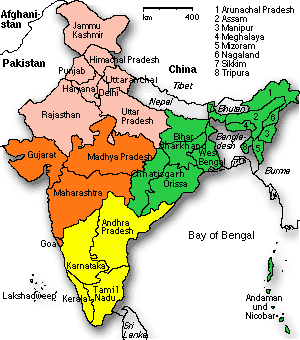
India geography


India geography

India is the seventh largest country in the world, as well as off the mountains and the sea, with the rest of Asia, and the country covers an area of ​​32,87,2631 provides a separate geographical entity.

Twitter Delicious Facebook Digg Stumbleupon Favorites More

 
Design by Free WordPress Themes | Bloggerized by Lasantha - Premium Blogger Themes | GreenGeeks Review